


Digital Twin, AI, Smart Building – What Is Reality and What Is Hype?
Stjepan Mikulic, an architectural AI influencer, arrived from Los Angeles at the Proptech Hungary conference to deliver an energetic and content-rich presentation on the successful implementation of artificial intelligence processes.
Stjepan Mikulic, who is of Croatian origin but lives and works in Los Angeles — and who jokingly said about the pronunciation of his name that “any version of Stefan works for me” — was introduced by Ágnes Gaschitz, the host of the second section of the Proptech Hungary conference, as “one of the most successful AI influencer superstars”. And, frankly, Stjepan’s stage presence and radiant business optimism more than justified that description.
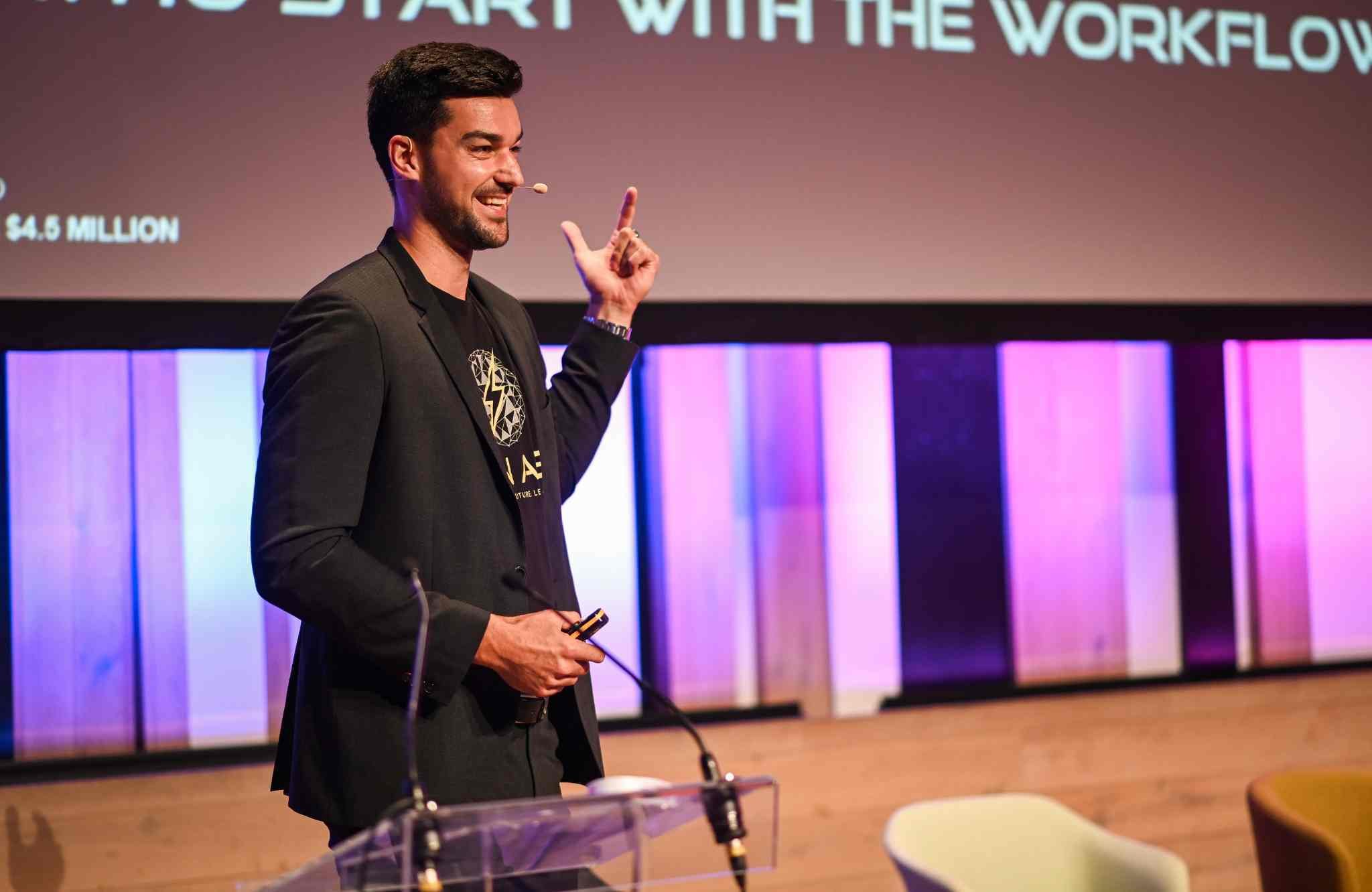
He started his career as an architect-engineer, but relatively soon found himself at the Swedish industrial architecture giant Sweco as a BIM Coordinator, and later worked at Bjarke Ingels Group as BIM Lead — an impressive career path, alongside which Stjepan still had the energy to follow the latest developments in artificial intelligence.
This eventually led to AI in AEC, a startup that integrates AI tools. At first, it was little more than a list that Stjepan himself kept expanding with AI tools that could be useful for real estate market players. This list of 1,800 items is still available for free on the company’s website. But the profile quickly expanded, and today the company primarily helps construction businesses navigate the AI tools market, from assessment to implementation.
“There are 16,000 AI companies on the market, but the ones leading the way are focusing on AI-based workflows,” Stjepan began his presentation, which carried the slightly provocative title “How I Saved 4.5 Million Dollars with AI”. He quickly clarified that “I am not an AI expert, I have not worked in it for decades,” but with the rise of ChatGPT, he became increasingly interested in how more and more efficient LLMs and generative AI solutions could be used in construction.
But choosing a tool is only the beginning. According to Stjepan, the real problems start when professionals begin using solutions that otherwise seem to fit. In his view, everyone wants a slice of this revolution, but they do not really know what the implementation of AI solutions involves, because many companies are not even aware of the problems within their own processes.
And this is the point: processes. If a company knows what workflows exist within it and can describe each of them, then those workflows can also be supported with the right artificial intelligence processes. In many cases, however, companies, driven by inertia, fall into the success they have already achieved and do not really understand what works in their organization and why. In fact, management often does not even care about operations as long as profit margins remain strong.
A business can be successful this way too, but only until it is forced to introduce new technologies — and this is where Stjepan’s most important knowledge comes into the picture. “We need to shift the focus from tool-centered thinking to work-centered thinking,” he said, using the already mentioned ChatGPT as an example. It is “cool, I can even write essays with it,” but how exactly that moves anyone forward in their work remains a rhetorical question.
By contrast, if we first identify the tasks — meaning that we also understand the workflows mentioned earlier — then we can assign tools to them, and not the other way around. “Maybe my problem is that I am drowning in emails. I receive a hundred emails a day! AI might solve that. Maybe ChatGPT, maybe some other tool. But the tool is not the point. The point is what the problem is,” he said. This mindset is useful not only when introducing AI, but also more generally, because it leads to structured operations, which in itself increases efficiency.
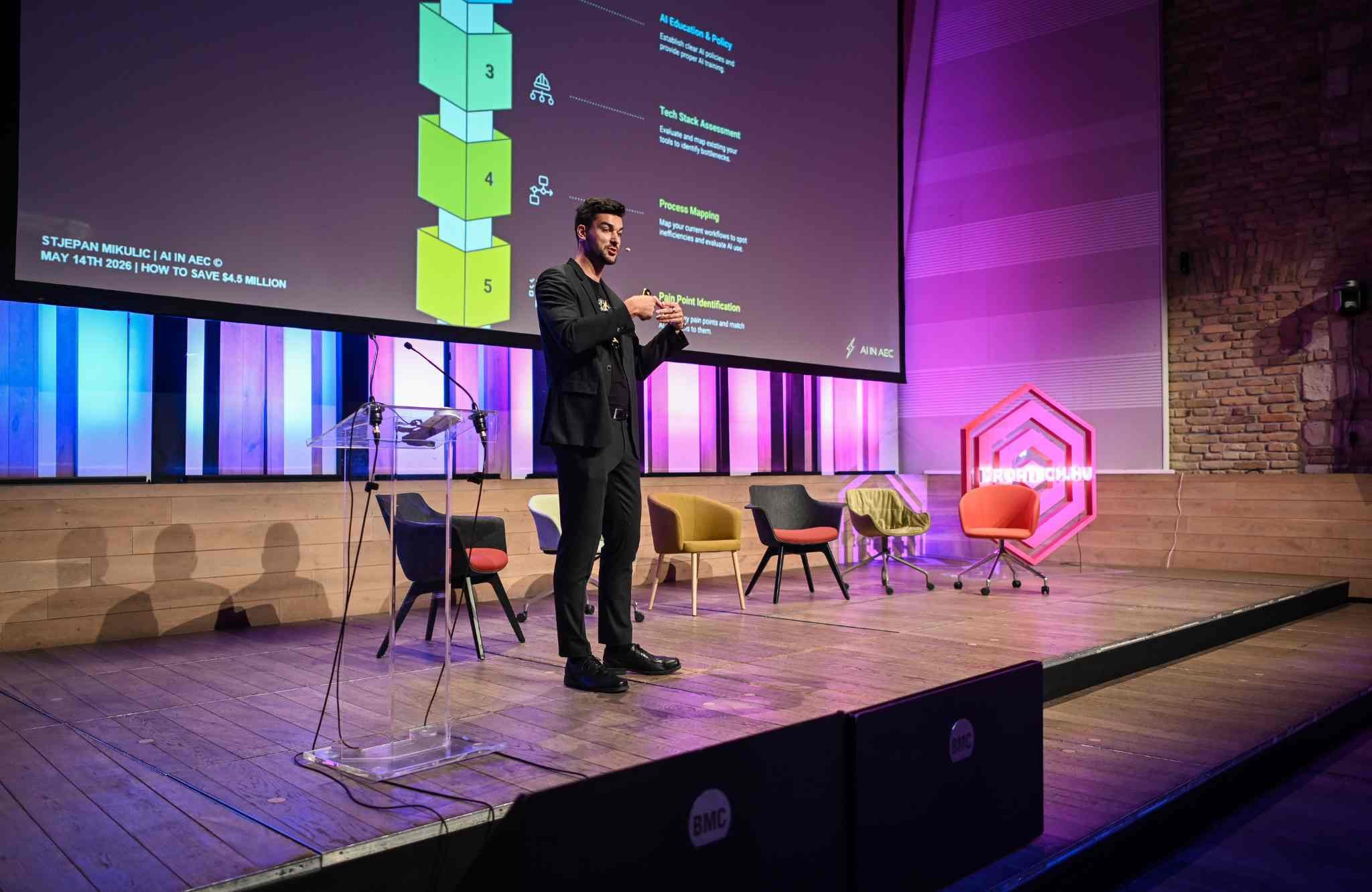
Stjepan describes the implementation of artificial intelligence as a ten-step process. It starts with the benefits promised by AI, continues with education, and is followed by identifying the necessary tools — this is the point where most people get stuck, and instead of moving forward, they hire more and more people to patch up old technologies. This is followed by identifying the processes, where the client often realizes that “look, this could actually work”, and then by finding the critical points — in other words, where the limitations of AI are.
Then come the remaining five steps, which are the actual implementation itself: the company’s own AI task force is formed, prototype and pilot developments begin, followed by analysis and then the integration of the technology. According to Stjepan, this always works and can also be done within a given company. External support is not necessarily required, although without it, the human dimension may not enter the picture, even though it is also important.
Not to mention the diverse nature of AI. Stjepan distinguishes between six different blocks, or in other words, six areas in which the impact of artificial intelligence branches out. Software is still obvious, but what it runs on — the hardware — is less so. And infrastructure has not even been mentioned yet, even though it cannot exist without a mature hardware strategy. On top of this, employees also need to understand what this whole thing is about, which Stjepan considers the most difficult part. Then comes regulatory compliance, and finally revenue growth. It is therefore clear that effective AI implementation has an impact on every aspect of a business.
And how does the 4.5 million dollar figure mentioned in the title of the presentation come together? Through fewer human working hours. This does not mean that employees no longer have tasks and everyone can go home, but it does mean that they can spend the time saved by AI more effectively. At the same time, the total salary cost paid for a project becomes lower — meaning that the money can be allocated to other work. All it takes is saving 12 working hours per week: the 4.5 million can be calculated for a 250-person company, with 100 AI-enabled employees and an hourly wage of 100 dollars. Obviously, it is not an exact figure, but the example illustrates the proportions well.
Despite the optimistic tone of Stjepan’s presentation, it remained realistic, full of numbers, data and real results. But perhaps his most interesting observation concerned companies that experiment with AI but ultimately judge it critically and negatively. “When I ask whether they have tried to implement AI, and they say yes, I often hear that ‘AI does not work’. What they actually mean is that ‘we have limited expertise in this field’.” And this is where it is worth returning to workflows: if we already understand them well before integrating AI, then we can also customize AI and use it to make our operations more efficient. From there, it is only one step to improving the business model as well.
The point is: we need to learn.