


Innovation, digitalization, proptech
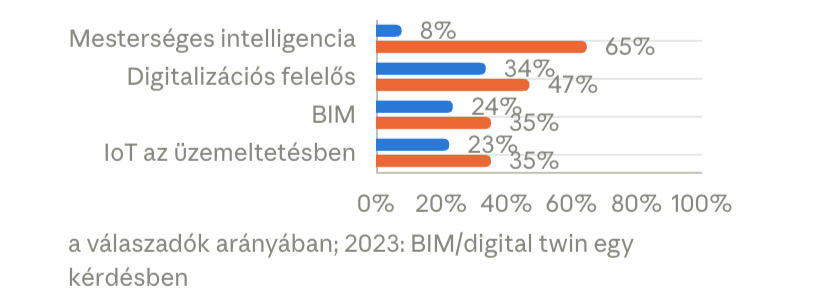
Between 2023 and 2025, one thing changed dramatically in the digitalization of the Hungarian real estate market: artificial intelligence jumped from 8% in 2023 to 65% among respondents. However, the structural problem remained: tools are spreading faster than data-driven decision-making, and organizational ownership is still missing at half of the companies.
The 2025 wave is based on 90 responses (2023: 91), so the percentages indicate trends rather than exact market sizes.
- AI broke through, but in a narrow band. 65% use AI in at least one area, yet usage is a majority in only one of the four examined areas. AI also leads upcoming implementations.
- More companies have an owner for digitalization. The share of those with a designated lead grew from 34% to 47%. However, only one in three companies has a digital transformation strategy.
- Having a dedicated lead is the biggest differentiator in both years. In 2023, companies with a lead scored 0.7 points higher on the sentiment index; in 2025, their maturity score is 1.7 points higher.
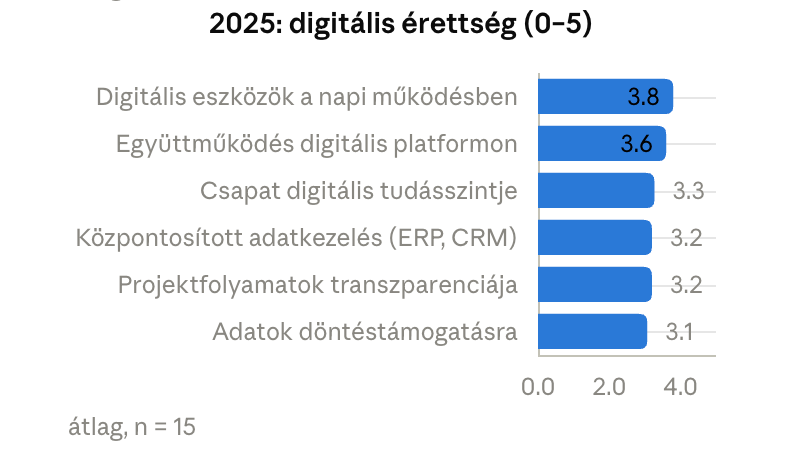
- Tools are present, data-driven decisions less so. In 2025, digital tool usage is highest (3.8/5), while using data for decision support is lowest (3.1/5). The same pattern appeared in 2023: 67% managed operations from Excel reports.
- FM firms and large enterprises lag behind in both years. Companies with 21 to 50 employees are the best prepared, while firms with over 100 staff and FM providers score below average.
- ESG digitalization has not taken off. In 2023, ESG measurement was the weakest metric (5.3/10); in 2025, 20% of respondents use software for ESG reporting.
Methodology and Sample
The two waves used two different questionnaires, so only topically matching questions can be compared directly.
Digital Maturity: 2023 vs. 2025
The two questionnaires measured on different scales, yet show the same pattern: companies rate intent and tool usage highest, and data-driven decision-making and impacts (ESG, talent attraction) lowest.
2023: high intent, moderate readiness. There was a 1.1-point gap between priority (7.8) and readiness (6.7). 63% of respondents rated digitalization at least 8 out of 10 in priority, while only 22% felt 9 to 10 points ready. Innovativeness and readiness moved closely together ($r = 0.77$).
2025: tools first, decisions second. The highest score is for daily digital tool usage, and the lowest is for using data in decision support. All six questions correlate strongly ($r = 0.63\text{--}0.88$): companies are either further ahead across the board or further behind across the board. Digitalization therefore comes as a package, not through introducing isolated tools.
The two 2025 responses using the older questionnaire both produced an average sentiment index of 8.3 (2023 average: 6.5), with 10/10 innovativeness. This fits the broader picture that more digitally active companies responded in 2025.
Limitations of comparison: The 2023 readiness score of 6.7/10 and the 2025 average of 3.4/5 indicate roughly the same level (both equal 67% of the scale maximum), but due to different question wording, neither improvement nor decline can be read from this alone.
Organization: Who Drives Digitalization?
In both years, a company's digital maturity is determined most strongly by whether the topic has a designated owner. This is a rare, clear correlation repeated across two independent samples.
|
Metric |
2023 |
2025 |
|
Designated digitalization lead / dedicated transformation role |
34% |
47% |
|
Internal IT development capacity |
47% |
56% |
|
Digital transformation strategy |
10% |
33% |
|
Maturity index with lead / without lead |
7/10, 6,3/10 |
7,6/10 vs 6,7/10 |
2023. Companies with a lead rated themselves more innovative (7.3 vs. 5.9) and more ESG-conscious (6.0 vs. 4.9). Having a lead and internal IT usually went together: 23 of the 30 companies with a lead also had internal developers. A lead rarely appeared below 20 employees: present at 10% of 1 to 5 person firms, and 55% of 21 to 50 person firms.
2025. Companies with a dedicated person have an average maturity of 7.6/10, while those operating without one score substantially lower. Companies with a strategy also have a dedicated person; the reverse is not true.
What does digitalization mean to companies? (2023) 96% associated it with efficiency, 60% with innovation, and 43% with monitoring; only 10% associated it with change and 11% with learning. The market views it as a cost- and time-saving tool rather than organizational transformation, which explains why a dedicated lead and strategy lag behind software purchases.
Software and Systems
Horizontal office tools (e-invoicing, cloud document repositories, Teams) were already standard by 2023. Enterprise management and real estate-specific systems, however, were missing at half or most companies, and in 2025 centralized data management still divides the market.
2023: System Usage
|
Sstem |
Using |
Planned in 6 months |
Not using |
Not relevan |
|
CRM |
51% |
7% |
33% |
4% |
|
Project / task management |
49% |
8% |
22% (+17% Excel/notebook) |
2% |
|
ERP |
46% |
11% |
30% |
6% |
|
FM system |
30% |
7% |
37% |
24% |
|
Property Management system |
22% |
4% |
49% |
24% |
Software named under "Other" was counted as usage. Nearly all respondents using a property management system indicated custom in-house development; on the FM side, APFM and ArchiFM were mentioned most often. 7% did not know what ERP meant.
Basic infrastructure, by contrast, was nearly complete: 89% receive and issue e-invoices, 84% use cloud document storage, 76% use Microsoft Teams, and 48% use electronic signatures. Facebook Messenger (27%) and Skype (20%) were still daily work tools.
2025: Centralized Data Management and Software Strategy
- Centralized data management (ERP, CRM): average 6.4/10; the market splits into two camps with little middle ground.
- Digital collaboration (Teams, BIM360): 7.2/10, the second-highest metric.
- Software model: mostly off-the-shelf or hybrid, with a smaller share using customized or in-house solutions.
Interpretation. Based on the 2023 "planned within 6 months" responses (ERP 11%, CRM 7%), coverage of both systems should have grown by 2025. The 2025 data neither refutes nor confirms this: the measured level (6.4/10) shows that centralized data management remains incomplete at half of the companies.
Technologies, AI, and Data-Driven Decision-Making
Within two years, AI moved from a peripheral technology to the most common next-generation tool, while BIM and IoT grew more slowly yet still expanded. Because of the 2025 sample composition, the magnitude of growth is closer to an upper estimate, though the direction is clear.
Artificial Intelligence
- Adoption. In early 2023, before the ChatGPT wave, 8% used AI; by spring 2025, 65%.
- Link to maturity. Companies using AI have an average maturity of 8.4/10, compared with 4.2/10 for non-users. AI is not a catch-up tool for laggards, but the next step for already mature companies, which tends to widen the digital gap.
- Next step. AI also leads among planned technologies.
Building-Side Technologies
In 2023, the most widespread were BMS (44%) and energy management (33%), while AR/VR (10%) and AI (8%) were rarest; 16% used none of them. In 2025, one-third of respondents use IoT in operations, while another third say it is not relevant to them. Companies working with BIM have a maturity score of 8.1/10, compared with 5.6/10 for those without BIM.
From Data to Decisions
This is the slowest-improving area. In 2023, 67% tracked operations via monthly or quarterly Excel reports (54% exclusively), while 24% used real-time dashboards. In 2025, "data for decision support" is the lowest maturity metric (6.2/10). On the FM side in 2023, 93% of companies used BMS, yet none reported data analytics: data is generated, but does not become a decision.
ESG
In 2023, ESG measurement was the weakest sentiment index metric (5.3/10), with 60% of micro-enterprises scoring below 4 points. By 2025, it had still not improved, with minimal software usage for ESG reporting and a smaller share planning it. Due to CSRD and supply-chain financing requirements, this is one of the most unavoidable tasks over the next two years.
Segments: Company Size and Activity
Two patterns repeat in both years: companies with 21 to 50 employees are the best prepared, while firms with over 100 staff and FM providers score below average. The 2025 subgroups consist of 1 to 5 companies, so they should be read as confirmation of the 2023 findings rather than on their own.
- The large-enterprise paradox. Companies with more than 100 employees have the most resources, yet score below average in both years. In 2023, half lacked a digitalization lead, and their innovativeness (6.1) and remote-work support (5.6) were below average. The likely cause is organizational complexity: more systems, more decision-makers, and harder integration.
- The 20-employee threshold. Below 20 employees, a dedicated lead and advanced technology are rare; above that threshold, both rise sharply. Companies with 21 to 50 staff are large enough for a dedicated lead, yet small enough for fast decisions.
- Lagging operations is the key segment finding. FM companies sit in the bottom third in both 2023 and 2025. In 2025, half of FM companies already use AI and IoT. Paradoxically, they hold the most building data (BMS 93% in 2023), and operations is one of the most measurably high-return areas of digitalization. Asset managers (2023) are most critical of themselves (8.4/10 innovativeness), even though portfolio-level decisions sit with them.
- Designers and consultants lead in both years. They perform software-intensive, knowledge-based work, with BIM (designers) and data analytics (consultants, 58% in 2023) part of daily operations.
Conclusions and Recommendations
The Hungarian real estate market is not digitally backward, but is splitting into two camps. Companies with a lead, strategy, and centralized data management also integrate AI quickly, while others buy tools without turning data into decisions. Between 2023 and 2025, technology changed, but the organizational pattern did not.
For Real Estate Companies (FM, PM, AM, Developers)
- Assign an owner to digitalization. Across two independent samples, this is the top differentiator between mature and lagging companies, and requires no software purchase. The lead should know business operations rather than be just the IT head.
- Strategy first, tools second. In 2025, two-thirds of companies lack a digital transformation strategy. Without one, new AI tools remain isolated silos just like Excel reports in 2023.
- Turn AI experiments into workflows. Most companies use AI in one or two areas. The next step is not another tool, but redesigning 2 to 3 measurable workflows such as issue reporting, tenant communication, or report preparation.
- FM and AM: turn existing data into decisions. BMS, energy, and maintenance data already exist; the missing link is integration and dashboards, not more sensors.
- Start ESG data collection now. Tenants, investors, and banks increasingly require it. Starting in 2026–2027 means acting under pressure and at higher cost.
- Large enterprises: integration over new systems. Underperformance above 100 employees stems from complexity rather than lack of tools. Compare the maintenance cost of custom PM and FM systems against market alternatives.
For PropTech Companies
- Sell efficiency, not innovation. 96% of the market links digitalization to efficiency, and only 10% to change.
- Target companies above 20 employees with a dedicated lead. Decision-making authority and absorption capacity sit there. Below 20 staff, the owner decides, requiring a shorter, more price-sensitive sales approach.
- The FM segment is the largest untapped market. High data volume, low maturity, and measurable ROI exist, yet most FM companies lack a digital lead and strategy, so sales start with advisory rather than a demo.
- Offer AI as an integrated feature, not a standalone product. Companies are already experimenting with it; what they lack is AI built into their existing systems.
- Awareness is the bottleneck. In 2023, one in four respondents could not name a single domestic PropTech company. Community presence and references carry more weight than advertising.