
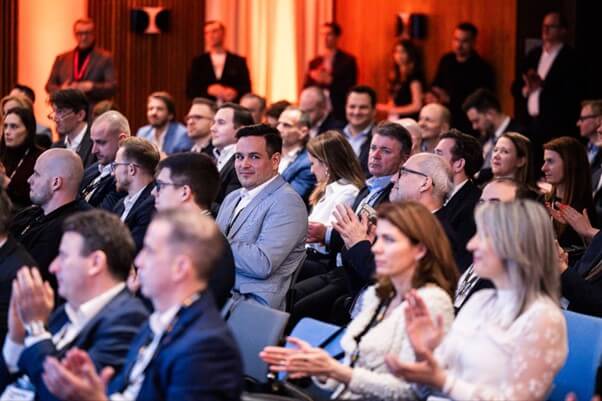
Portfolio Property Warm Up 2026, the first real estate conference of the year, once again addressed the industry’s most pressing issues, covering the elections, new opportunities, and current challenges. Participants spoke openly about the wait-and-see attitude caused by the April elections and the importance of predictability in the regulatory environment. The conference highlighted that developing strategies for tourism, urban development, and housing is essential for future growth. For the first time this year, ProptechZoom also presented on the topics of digital maturity, digital competence, and challenges, as the organizers recognize the market’s shifts in this direction.
According to Miklós Gyertyánfy, CEO of Gránit Pólus, tourism is one of the most stable and growth-oriented sectors for real estate developers. He highlighted the professional support for the Budapest Airport Railway and its positive impact on Budapest’s competitiveness. Speaking about the technological revolution, he described the capital market’s reaction to AI as a warning sign, while also mentioning practical applications such as AI-based optimization of building operations (with double-digit energy savings potential), support for customer service processes, and the acceleration of data collection and processing. He emphasized the importance of organizational learning and employee training, including through collaboration with international proptech partners.
The presentation highlighted how AI is changing everything. The presentation highlighted the exponential development of artificial intelligence capabilities, demonstrating that AI is no longer limited to simple, perceptual tasks (handwriting, image, and speech recognition) but can also perform higher-level cognitive functions such as text comprehension, reasoning, coding, and autonomy. The presentation sharply criticized the obsolescence of current real estate market software and the overuse of Excel in the real estate market. The slow adaptation of old, traditional players to cloud technologies, their lack of readiness for innovation, and their struggles with basic product maintenance require attention and continuous improvement and development.
Particularly relevant was McKinsey’s list of “Next Arenas of Competition,” which identifies 15 key industries as the most important economic and technological battlegrounds of the future. By linking these to the real estate market, we can see which areas will be in focus in the coming period, and how e-commerce, cloud services, electric vehicles, modular construction, robotics, and AI software will reshape real estate development and operations. This list suggests that the future of the real estate market is not just about building traditional homes and offices, but about adapting to new demands generated by technological changes. In some investor rankings, the office market and traditional residential real estate are no longer top categories; instead, data centers, energy infrastructure, student housing, logistics, and rental housing are coming to the forefront.
However, the biggest obstacle is not the availability of technology, but the organizational mindset: short-term, bonus-driven corporate logic, a culture that punishes mistakes, mistrust, and slow decision-making all hinder true renewal—as the example of Kodak illustrates, a good idea alone is not enough if the organization is not prepared to embrace it. According to the expert, AI is no longer merely a tool but increasingly a decision-support and decision-making system (especially with so-called “AI agent” approaches), so the real question will be who uses it and for what purpose; To prepare for this, he recommended that real estate market players establish dedicated innovation teams separate from operations, consciously build digital and implementation competencies, ensure greater transparency, adopt data-driven operations, and foster a culture of controlled experimentation.
The Portfolio Warm Up 2026 conference clearly demonstrated that the real estate market is on the verge of an extremely dynamic period marked by significant changes. The AI revolution, the growing emphasis on sustainability, the transformation of work habits, and the need for organizational innovation are all factors that are fundamentally reshaping the industry’s future. The proptech companies and real estate market players that will succeed are those capable of adapting quickly, open to new technologies, and willing to step outside traditional frameworks.